Locksley Resources (LKY:AU) has announced 400% Increase in Antimony Target Strike Length
Download the PDF here.
This post appeared first on investingnews.com

Locksley Resources (LKY:AU) has announced 400% Increase in Antimony Target Strike Length
Download the PDF here.
Highlights
– Structural mapping expands target mineralised corridor at Desert Antimony Mine (DAM) fourfold to 1.2 km, dramatically increasing the exploration target footprint and scale potential
– New parallel structural target zone identified 150m west of the main DAM structure, indicating the potential for a multi-zone system
– Updated 3D geological model defines seven priority follow up surface sampling targets, supporting imminent exploration targeting and JORC Exploration Target work
– Regional mapping identifies lamprophyre dykes, highlighting potential for additional critical mineral occurrences including carbonatites
– Mojave emerging as a district-scale critical minerals hub, strategically aligned with accelerating U.S. onshoring policies
– Third phase structural mapping program to commence late November to continue building geological understanding of the project and identify new targets
– High-grade silver assays up to 216 g/t Ag returned from Hendricks Prospect, alongside anomalous Zn, Pb, and Cu, indicating a broader polymetallic system
The structural geology mapping completed in late August/September 2025 at the Mojave Project has expanded the strike extent of the target structure at the Desert Antimony Mine (DAM) Prospect from 0.3 km to 1.2 km, representing a ~400% increase and highlighting the potential of the system. Mapping confirmed the continuity of the NNE-striking structural zone that hosts high-grade stibnite mineralisation at DAM, and identified a second, parallel shear zone, approximately 150 m to the west, exhibiting similar alteration and structural characteristics.
The updated geological interpretation also highlights steep north-plunging intersections between the mapped shear zones and folded host rocks as possible mineralisation plunge controls. Collectively, these findings have been incorporated into a new 3D geological model, which has defined seven priority surface sampling targets to guide the next phase of exploration and support the development of a JORC Exploration Target to guide future drilling programs.
The scale and geometry of these target zones align with the type of high-grade, clean stibnite feedstock required to fast-track U.S. antimony supply chains under programs such as DPA Title III and DOE ARPA-E. The program, undertaken by a specialist structural geologist, delivered five key outcomes:
– Significant expansion of geological mapping to the northeast and southwest of the DAM Prospect, extending the target horizon to 1.2 km of strike and materially increasing the scale potential of the mineralised system.
– Completion of new geological maps for the Hendricks Prospect (2.5km south east of DAM) and the Junipero Prospect (1.1km north of the Mountain Pass Mine).
– Identification of multiple lamprophyre dykes across all areas mapped suggest the presence of deepseated mantle tapping structures.
– Updated 3D geological models across the claim package, providing enhanced structural understanding and supporting refined exploration targeting
– Definition of 18 priority target areas for follow-up detailed mapping and intensive sampling programs to further assess mineralisation potential (to commence in October).
Desert Antimony Mine (DAM)
Mapping at DAM focussed on extending to the NE and SW from the previous mapping campaign, resulting in a comprehensive geological map now covering ~1.8km of strike and the development of an updated 3D geological model (Figure 1*). This work has significantly enhanced the understanding of the structural framework and potential controls to mineralisation. Key highlights from mapping and modelling in this area include:
– Confirmation of continuity of the structural zone (which is host to the mineralisation at DAM) for approximately 400m NNE from the existing adits.
– Identification of a second parallel structural zone located approximately 150m west of the main mineralised trend, exhibiting a comparable alteration signature and kinematics to that seen at DAM.
– Extension of the target mineralisation corridor to ~1.2km (previously ~0.3km) representing a ~400% increase in strike length.
– Improved understanding of mineralisation controls, particularly the role of steep north plunging intersections between mapped shears and folded host rocks.
– Definition of seven priority areas for detailed follow up sampling and mapping to refine exploration targeting.
– Enhanced structural interpretation, revealing clear associations between E-W trending stratigraphy and regional fold hinges and NNE striking shear zones, critical for targeting additional mineralised zones.
– Completion of an updated 3D solid geology model, providing a robust foundation for refined drill planning, target prioritisation and the potential definition of a JORC Exploration Target (Figure 1*).
Hendricks Prospect
First pass mapping was undertaken at the Hendricks Prospect (Figure 1*). The area was selected as a priority target area for mapping due to rock chips previously collected by Locksley being elevated in REE.
A significant finding from the mapping was the identification of a substantial shaft and associated workings not previously known by the Company. Initial grab sampling has returned high-grade silver assays of 216g/t Ag with anomalous lead (0.3% Pb), Zinc (0.9%Zn) and Copper (0.1%).
Highlights from mapping and modelling in this area include:
– The overall structural architecture across the Hendricks prospect area shares many similarities with that surrounding the Desert Antimony Mine (DAM).
– Presence of multiple NNE striking shears throughout the mapping area which mirror the orientation of the mineralisation seen at DAM, demonstrating a regional structural consistency and potential for additional zones of mineralisation.
– Highly weathered and altered ENE to ESE striking shear zones with potential to host mineralisation
– Elevated scintillometer readings acquired from on syenogranite dykes, indicating potential for REE mineralisation.
– Multiple prospecting pits/costeans throughout the area proximal to the Hendricks Shaft targeting discrete NNE striking shear zones.
– Definition of 11 priority areas for detailed follow up sampling and mapping.
– A 3D solid geology model of Hendricks Prospect is underway and will be used for 3D target generation and drill program planning.
Mapping completed at the Hendricks Prospect Area has confirmed that target zones of interest continue to the south and will form part of the priority follow up mapping scheduled for late November 2025.
Junipero Prospect
First pass mapping was completed at the Junipero Prospect located just 1.1km north of the Mountain Pass Mine pit crest. The area was targeted due to a gravity high anomaly, the proximity to Mountain Pass and the potential for carbonatites to be found in the area. Highlights from mapping and modelling in this area include:
– Identification of multiple E-W trending lamprophyre dykes across the mapping area indicating deep seated mantle tapping structures highlighting the potential for REE hosting carbonatites throughout the area which could exploit the same pathways.
– Abundant felsic rocks (Tonalites, Syenogranites) providing potential sources of REE when assimilated with carbonatite magmas from the mantle.
– Collection of samples for multielement analysis and whole rock classification.
– A 3D solid geology model of Junipero Prospect has been completed and forms part of the DAM 3D geological model (Figure 1*) and will be used for ongoing 3D target generation and future activity.
Locksley Resources CEO Kerrie Matthews commented:
‘Our second structural mapping program at the Mojave Project has markedly advanced our geological understanding and confirmed the substantial exploration potential of this critical district. The fourfold expansion of the Desert Antimony Mine (DAM) target horizon has fundamentally changed the scale of the opportunity, demonstrating the potential for a much larger mineralised system. This success, coupled with high-grade silver confirmed at Hendricks and the identification of multiple regional shear zones, has effectively lit up the entire Mojave Project for polymetallic vein discoveries. These outstanding results strongly validate our rapid exploration and development strategy, aligning perfectly with the accelerating U.S. government focus on securing domestic critical mineral supply chains.’
*To view tables and figures, please visit:
https://abnnewswire.net/lnk/7WY0FHM0
About Locksley Resources Limited:
Locksley Resources Limited (ASX:LKY,OTC:LKYRF) (FRA:X5L) (OTCMKTS:LKYRF) is an ASX listed explorer focused on critical minerals in the United States of America. The Company is actively advancing exploration across two key assets: the Mojave Project in California, targeting rare earth elements (REEs) and antimony. Locksley Resources aims to generate shareholder value through strategic exploration, discovery and development in this highly prospective mineral region.
Mojave Project
Located in the Mojave Desert, California, the Mojave Project comprises over 250 claims across two contiguous prospect areas, namely, the North Block/Northeast Block and the El Campo Prospect. The North Block directly abuts claims held by MP Materials, while El Campo lies along strike of the Mountain Pass Mine and is enveloped by MP Materials’ claims, highlighting the strong geological continuity and exploration potential of the project area.
In addition to rare earths, the Mojave Project hosts the historic ‘Desert Antimony Mine’, which last operated in 1937. Despite the United States currently having no domestic antimony production, demand for the metal remains high due to its essential role in defense systems, semiconductors, and metal alloys. With significant surface sample results, the Desert Mine prospect represents one of the highest-grade known antimony occurrences in the U.S.
Locksley’s North American position is further strengthened by rising geopolitical urgency to diversify supply chains away from China, the global leader in both REE & antimony production. With its maiden drilling program planned, the Mojave Project is uniquely positioned to align with U.S. strategic objectives around critical mineral independence and economic security.
Tottenham Project
Locksley’s Australian portfolio comprises the advanced Tottenham Copper-Gold Project in New South Wales, focused on VMS-style mineralisation
Source:
Locksley Resources Limited
Contact:
Locksley Resources Limited
T: +61 8 9481 0389
E: info@locksleyresources.com.au
News Provided by ABN Newswire via QuoteMedia

The Nobel Committee awarded this year’s peace prize to Maria Corina Machado amid calls for President Donald Trump to receive the award in the wake of his brokering a historic deal between Israel and Hamas.
Machado, a Venezuelan opposition leader, was described as a ‘brave and committed champion of peace’ by Joergen Watne Frydnes, chair of the Norwegian Nobel Committee.
‘She is receiving the Nobel Peace Prize for her tireless work promoting democratic rights for the people of Venezuela and for her struggle to achieve a just and peaceful transition from dictatorship to democracy,’ Frydnes said.
Trump has received several high-profile nominations since returning to office. However, the committee’s deadline for nominations was Jan. 31, meaning he could be eligible for next year’s prize.
During a Cabinet meeting on Thursday, Trump was asked about the Nobel Peace Prize, but did not comment on the award in his response. Instead, he focused on the possibility of addressing Israel’s Knesset.
Earlier this week, the Hostages and Missing Families Forum, a group representing the families of hostages and terror victims formed after Oct. 7, appealed to the committee on Trump’s behalf.
‘In this past year, no leader or organization has contributed more to peace around the world than President Trump. While many have spoken eloquently about peace, he has achieved it. While others have offered empty promises, he has delivered tangible results that have saved countless lives,’ the forum wrote in a letter to the committee dated Oct. 6.
‘He has not merely spoken of peace — he has delivered it,’ the forum added.
Israeli Prime Minister Benjamin Netanyahu told Trump in July during a visit to Washington, D.C., that he had nominated the president for the Nobel Peace Prize. Netanyahu handed the letter he sent the committee to Trump when he told him the news.
‘The president has already realized great opportunities. He forged the Abraham Accords. He’s forging peace, as we speak, in one country and one region after the other,’ Netanyahu said. ‘So, I want to present to you, Mr. President, the letter I sent to the Nobel Prize committee. It’s nominating you for the peace prize, which is well-deserved.’
Weeks prior to that meeting, the U.S. and Israel carried out major operations that destroyed Iran’s nuclear infrastructure, as both countries warned a nuclear Tehran would be a threat to the world.
Trump was nominated for the award in the past but was not selected. Notably, U.S. Rep. Claudia Tenney, R-N.Y., nominated Trump for the prize in 2020 when he brokered the Abraham Accords, normalizing relations between Israel and Arab nations.
Had he won, Trump would have become the fifth U.S. president to win the Nobel Peace Prize. Previous laureates include former President Barack Obama, former President Jimmy Carter, former President Woodrow Wilson and former President Theodore Roosevelt.
Fox News Digital’s Greg Wehner and Caitlin McFall contributed to this report.

Nothing woke America up to the realities of gender ideology quicker than the photo of Riley Gaines standing next to her National Championship opponent, a 6’1′ male towering over her with his broad shoulders and smoldering grin. You felt it in your bones – this isn’t right.
The moment sparked a nationwide campaign to try and convince everyday Americans that this feeling was not just instinct; it was internalized bigotry and evidence that there was noble, progressive work still to do. Only one problem. It was all a lie. And recent admissions show that not even the top Democratic leaders believed what they were selling.
Just five years ago, I was a freshman in college, testifying in my dorm room about a bill that stated men cannot compete on women’s sports teams. ‘Politics are crazy,’ I thought, ‘Why do I even need to testify on something so obvious?’
I quickly learned of my own naivety when the bill did not pass in my very conservative state. ‘This isn’t a real issue,’ they insisted while I, a female athlete who had previously competed against a man, sat in front of them. There was clearly much more to this problem than I realized.
When the spotlight on the issue grew, it was somehow immediately deemed partisan. The issue was linked to the Democrats’ pro-LGBTQIA+ position, which they had insisted was the civil rights issue of our time, and now it was squarely at odds with something plainly unjust. But they were in too deep.
At every turn, those who tried to find solutions to the problem of men in women’s sports, including traditionally far-left organizations like Women’s Liberation Front, found themselves up against the powerful political operatives of the Democratic Party. Though the ties between LGB and T were fading, the radical left insisted that to be pro-gay or pro-woman, you had to also stand for men in women’s sports. Democrats obliged.
In some ways, this makes sense. If the Democrats acknowledge that sex exists in sports, then what does this mean to other parts of their agenda that rely on sex-denying ideology? The crusade to abolish sex is one that spans decades, and they are not about to budge now. So, they doubled down, even redefining ‘sex’ as ‘gender identity’ wherever they could, including in landmark pro-woman legislation like Title IX, and they continued to label anything contrary as ‘extreme’ through the 2024 election.
Concerned Women for America LAC exit polling suggests this issue played an outsized role in the election, and the Democrats paid the price with a resounding loss in both chambers of the federal government and the White House. Voters did not buy the lie that their concerns were merely internalized bigotry. And at least some Democrats are finally ready to face the music and speak more openly about it.
The Democrats’ highest-ranking figure has finally addressed one of the biggest political flops of modern history, and while her confession is unsurprising, it should shake the party to its core.
In her recently released book about her presidential candidacy, former Vice President Kamala Harris admits that she, too, shares concerns: ‘I agree with the concerns expressed by parents and players that we have to take into account biological factors such as muscle mass and unfair student athletic advantage when we determine who plays on which teams, especially in contact sports.’
But she added, ‘There was no way I was going to go against my very nature and turn on transgender people.’
And there it is. Tension unmasked. When reality collides with allegiance, the Democrats choose allegiance.
The highest leaders of the party know they were ignoring the real, reasonable and consequential concerns of millions of women. Abandoning women and their safety was a calculation worth making in their eyes.
Harris is not alone. California Gov. Gavin Newsom has publicly admitted that this is ‘an issue of fairness – it’s deeply unfair.’ Yet, his state is one of the worst offenders of women’s rights in this area.
On this Worldwide X/X Day (Real Women’s Day), the good news is that some party members are choosing reality and abandoning ship. Just a few weeks ago, 10 House Democrats voted, for the first time, for a National Defense Authorization Act amendment that would keep men from competing on women’s athletic teams at service academies. Just a few months ago, most of these same members refused to vote for a bill with similar protections.
As we hope this issue joins the parade of failed civil rights attacks of times gone by, voters and candidates alike should heed the warning. Never stand for a lie. Truth is our only sure foundation. Policy must be based on reality.
We know wrong when we see it. It is instinctive, and often clearly on display, like that photo of Riley Gaines’ medal being given to a male.
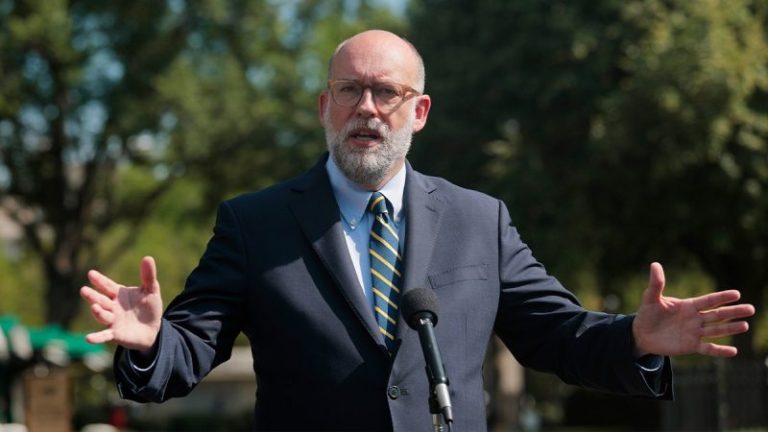
Senate Republicans are taking a hands-off approach to threats from White House budget chief Russ Vought, arguing that his pressure on Senate Democrats to reopen the government, for now, is warranted.
Away from the gridlock on Capitol Hill, Vought, who is the director of the Office of Management and Budget (OMB), has made moves to pressure Senate Democrats, led by Senate Minority Leader Chuck Schumer, D-N.Y., to reopen the government.
Before the shutdown started earlier this month, the OMB released a memo to government agencies instructing mass firings beyond the typical furloughs of nonessential employees during government shutdowns. He has since withheld nearly $30 billion in infrastructure funding to blue states and cities.
And earlier this week, a memo circulated around the White House that suggested that furloughed employees would not receive back pay when the government reopened — a move that runs counter to a law signed by President Donald Trump in 2019.
‘We heard earlier, right at the beginning of the shutdown, that we may see some terminations, some firings within the department,’ Sen. Lisa Murkowski, R-Alaska, told Fox News Digital. ‘We saw a lot of big numbers kind of thrown around, and they haven’t materialized, which I think is good, but certainly what it does, it’s very unsettling.’
The administration’s latest actions come as conversations on a path out of the shutdown have been ongoing. For now, Republicans don’t believe that Vought’s moves are undercutting those talks.
Sen. John Hoeven. R-N.D., told Fox News Digital that Vought was what Vought ‘thinks probably helps push Democrats to come to the table and open the government back up.’
‘I mean, that’s for him to decide,’ he said. ‘What I’m looking to do is to try to talk to enough Democrats, and I hope that between reaching out to them and pressure they get from back home, we can get the government open and back to work on these things.’
Senate Majority Leader John Thune, R-S.D., told Fox News Digital that the administration was ‘going to do what they’re going to do, and they’ve got to manage this, and they’re going to manage it according to their priorities.’
‘I think they’re trying to be sensitive to discussions up here that might be productive,’ Thune said. ‘But, you know, as of right now, it’s like I said before, all this stuff is just kind of window dressing until we fundamentally get down to the issue about, are we going to open up the government or not?
‘And I think when all those issues go away, these guys, the things that the White House is talking about doing or hinting that they might do, become unnecessary,’ he continued.
Senate Democrats are demanding a deal extending expiring Obamacare subsidies, and won’t provide the votes needed to reopen the government unless they get more than a guarantee to tackle the issue.
Thune and Senate Republicans are adamant that they will negotiate on extending the tax credits, with reforms baked in, only after the government reopens. And so far, as the stalemate has dragged on, neither Vought nor the administration have taken action on their threats of mass firings or back pay.
‘Right now it’s fine,’ Sen. Thom Tillis, R-N.C., told Fox News Digital. ‘If he starts taking Draconian sorts of actions, then I think it creates a more difficult scenario for us. It puts us further away from what he wants to get accomplished, too.’
Still, Senate Democrats have not taken kindly to his overtures.
Sen. Gary Peters, D-Mich., told Fox News Digital that there was ‘no question’ Vought was hurting ongoing talks between the parties.
‘Russ Vought is basically acting like a bomb thrower, and bomb throwers are never helpful in negotiations,’ he said.
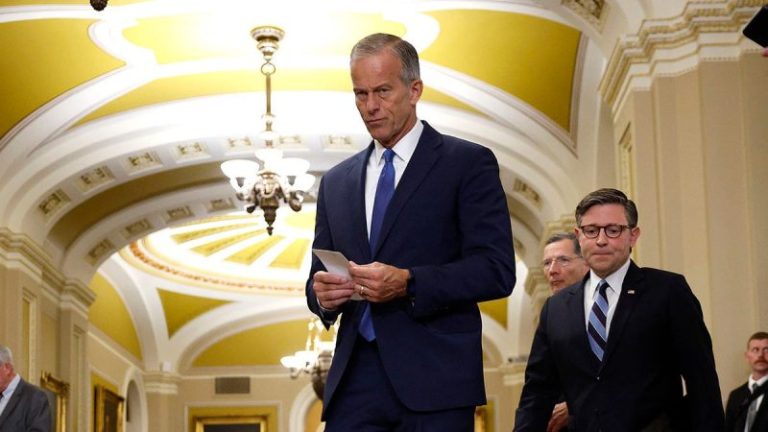
The Senate is set to leave town on Friday until early next week as neither side is ready to give in the ongoing government shutdown stalemate.
Lawmakers voted deep into the night on Thursday on the 2026 National Defense Authorization Act, which advanced on a largely bipartisan vote. But the $925 billion package, which authorizes funding for the Pentagon, was effectively the last hurrah for the week in the upper chamber.
While there was discussion of putting the House GOP’s continuing resolution (CR), along with congressional Democrats’ counter-proposal, on the floor for one last vote, the plan never came to fruition. Both would likely have failed for an eighth consecutive time.
Senate Republicans and Democrats will instead return on Tuesday next week, after observing Columbus Day, to continue the ongoing back and forth on the GOP’s CR following a week of trying and failing to pass the bill and reopen the government.
Senate Majority Leader John Thune, R-S.D., plans to continue bringing the Republicans’ bill to the floor in an effort to fragment Senate Democrats. So far, only three Democratic caucus members have consistently split from their largely unified party.
Talks have continued in the background behind closed-doors, but nothing has quite yet materialized into full-blown negotiations on expiring Obamacare, formally known as the Affordable Care Act (ACA), tax credits to find an off-ramp as the government shutdown barrels into a third week.
‘The ACA issue is important to a lot of us, not just to Democrats,’ Sen. Susan Collins, R-Maine, said. ‘The tax subsidies were enhanced during COVID. They do need to be reformed, but they do need to be extended as well.’
Sen. Markwayne Mullin, R-Okla., is one of a handful of Republicans consistently meeting with Democrats. He said he’s not meeting with lawmakers ‘so dug in that they can’t get off their position,’ but still, no movement across the aisle has happened.
Mullin and other Republicans want to pass their short-term CR until Nov. 21, while Senate Democrats are adamant that, unless there is a deal on the ACA subsidies, they won’t provide GOP with the votes to reopen the government.
‘Well, if it continues, the way it’s gone, the longer we go, the harder it is,’ Mullin said. ‘It’s a big task. Anything to do with ACA or healthcare, you get a lot of moving parts. I think that gets very difficult the longer this thing [goes on]. You get into next week. I mean, we’ve got four and a half weeks left, right, and so that timeframe keeps getting shorter.’
Their return next week also all but guarantees that members of the military will not receive their paychecks on time, given that the date to have payroll locked in and processed falls on Monday.
‘Certainly, if folks miss a paycheck, the intensity will go up,’ Sen. Shelley Moore Capito, R-W.V., said.
The continued gridlock has most in the Senate GOP unwilling to consider turning to the ‘nuclear option,’ a move they made last month when they unilaterally changed the Senate’s rules for confirmations on nominations to break through Senate Minority Leader Chuck Schumer, D-N.Y., and his caucus’ blockade of President Donald Trump’s nominees, to change the filibuster.
‘There’s always a lot of swirl out there, as you know, from, you know, social media, etc., but no, we’re not having that conversation,’ Thune said.
But not every Republican wants to ignore nuking the 60-vote filibuster as, day in and day out, the GOP’s plan to reopen the government falls five votes short.
Sen. Bernie Moreno, R-Ohio, said that if the shutdown continues, it’s an option that should be considered.
‘Look, 50%, 60% of Americans live paycheck to paycheck,’ he said. ‘We’re going to trip that wire next week. Now if there’s another paycheck — that’s probably 80% of Americans that can’t go without two paychecks in a row. I think at that point we have to look at it and say ‘the Democrats are still doing political stunts.’’
Republicans also found a new point of attack against Democrats. Schumer told Punchbowl News in an interview that ‘Every day gets better for us,’ in his assessment of Senate Democrats’ political momentum as the shutdown marches onward.
‘Who is ‘us?’ Not better for the American people,’ Senate Majority Whip John Barrasso, R-Wyo., said. ‘Who does he mean by ‘us?’ Not the military who is not getting paid. Not the Border Patrol who are not getting paid. Not the air traffic controllers who are not getting paid. Who is ‘us?’ He’s playing a game!’
But Senate Democrats are largely shrugging off the issue. Sen. Brian Schatz, D-Hawaii, contended that it was Republicans’ latest attempt to ‘change the topic from 114% increase in premiums,’ a point Democrats have argued could happen if the Obamacare tax credits aren’t extended.
‘They’re a little desperate to change the news cycle, and this is their latest attempt,’ Schatz said.

President Donald Trump turned heads when he signed a recent executive order promising to defend the state of Qatar from attack and – in so doing – protect U.S. interests. The language of the order is clear: if Qatar is attacked, ‘the United States shall take all lawful and appropriate measures – including diplomatic, economic, and, if necessary, military.’
This move comes after Israel, another close American ally, hit Qatar with airstrikes targeting Hamas officials. Some people who don’t understand the full context of the president’s Middle East peace strategy have questioned this order, even though Israeli Prime Minister Benjamin Netanyahu has since apologized for the strikes and promised no further action in Qatar.
The truth is that Trump’s executive order is yet another example of his abiding commitment to protecting American interests in the Middle East. During his first term, he declared that ‘The nation of Qatar, unfortunately, has historically been a funder of terrorism at a very high level.’
The Biden administration rewarded Qatar’s support during its withdrawal from Afghanistan by designating the nation a major non-NATO ally in 2022. We are in a new strategic calculus surrounding Qatar, and this is the context in which Trump has taken such a bold move.
President Trump is interpreting the strategic moment unlike any United States president before him. The Qatar announcement puts all parties in the region on notice: Israel conducted military strikes against Doha. It won’t do that again any time soon. Iran struck Qatar. It will think long and hard about doing anything close. The Saudis have paired up with the Pakistanis for mutual defense. Trump has done a checkmate. The political office of Hamas in Qatar is just less relevant now.
Trump is forcing peace by clarifying options and the game for long-standing divisions from the Levant to the Gulf. This is bringing the broader Middle East closer to peace than it has been in years.
Who else could staunchly support Israel’s right to defend itself from Hamas and Iran’s nuclear program while simultaneously being tough on Netanyahu to actively pursue peace? There’s a tremendous amount of nuance in this approach.
Here is the president’s goal: A durable peace deal, not just between Israel and Hamas, but one that brings all parties in the Middle East to the table. This is why the United States has been so involved in brokering a deal in the Middle East and has relied on the positive relationships that Trump has built through trade and diplomacy.
America has been clear that there is some room for negotiation, but some things won’t change. Primary among them is that Hamas must disarm. This is a prerequisite to any lasting peace and Trump knows it. That’s why the 20-part plan is take it or leave it on the condition of disarmament.
Further evidence of the genius of this approach is the broad support the plan has received from disparate countries, both in the Middle East and in Europe. It has garnered support from countries that are both for and against Palestinian statehood. The plan has served as a unifying beacon to a region (and a world) that has long wanted peace but has never had a leader courageous and tenacious enough to make that dream a reality.
Another outcome of this broad support is the true isolation of Hamas. They’re the only ones who are for their continued militarization. In effect, by their protracted resistance to peace, they have alienated almost everyone who may be sympathetic to some of their nonviolent goals. That puts Hamas under enormous pressure – pressure that is both intentional and calculated to move the Middle East toward lasting peace.
All this comes while Trump has doubled down on American and European support of Ukraine to find a way to speed up the end of Europe’s horrible war, yet another example of the administration keeping promises made during the presidential campaign. The approach should sound familiar.
The president provided Russia with every opportunity to end the conflict peacefully. Despite that effort, Moscow refused and has continued its aggression toward Ukraine. Now, as a last resort — just like the situation with Iran’s nuclear program – the United States is providing additional support to its allies, all in service of the ultimate goal, which has always been and will always be lasting peace, not just for the Middle East, but for the world. Trump is determined to be the peace strategist.
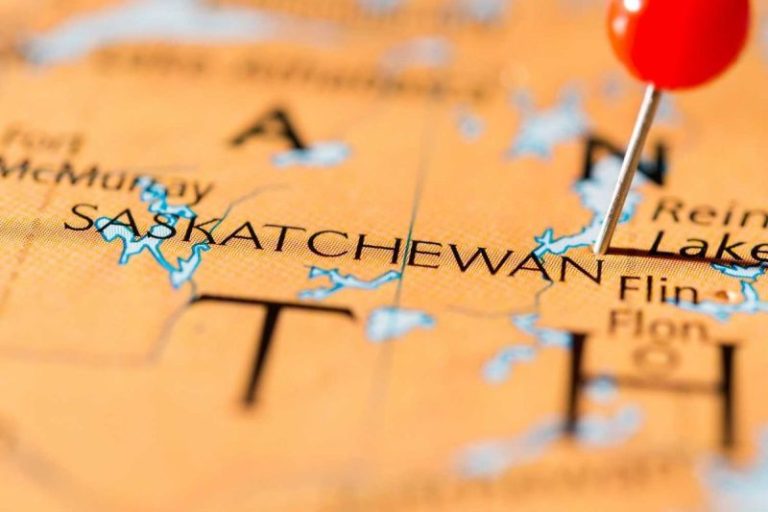
Saskatchewan has introduced a new royalty framework for lithium production, marking a major step toward supporting the province’s growing role in Canada’s critical minerals sector.
The amendments to 2017 subsurface mineral royalty regulations formally establish a 3 percent Crown royalty on the value of brine mineral sales, coupled with a two year holiday for new productive capacity.
Provincial officials said the change aligns Saskatchewan’s royalties for lithium with those already applied to potash, salt and sodium sulfate, and keeps the province competitive with leading jurisdictions worldwide.
“Lithium is a critical mineral that is expected to see strong demand and growth in the decades ahead, and Saskatchewan is well-positioned to take advantage of this opportunity,” Energy and Resources Minister Colleen Young said.
“By putting this royalty framework in place now, we are providing certainty for industry, while ensuring the people of Saskatchewan benefit as this sector develops,” Young added.
Industry participants have welcomed the move, calling it a clear signal that the province intends to be a serious player in the global lithium supply chain. Canada-based explorer EMP Metals (CSE:EMPS,OTCQB:EMPPF) described the royalty rate as internationally competitive and a meaningful boost for project economics.
“This is very welcome news. The government of the province of Saskatchewan has once again proven itself to be supportive of lithium production in the province,” EMP Metals CEO Karl Kottmeier said. “This is a highly competitive royalty rate internationally, and a two-year royalty holiday on new production immediately makes a positive impact on financial modelling of what is already a compelling business case for our Project Aurora lithium production project.”
Grounded Lithium (TSXV:GRD) President and CEO Gregg Smith noted that the policy encourages further investment, while recognizing the high upfront costs of developing processing capacity.
“This new regulatory framework provides a reasonable royalty rate while also recognizing the significant risk and initial investment companies make in processing facilities to ultimately achieve commercial production,” he said.
Saskatchewan has emerged as one of Canada’s top destinations for mining investment. The Fraser Institute’s annual mining company survey ranked it the country’s leading jurisdiction, with the province projected to attract over US$7 billion in mining investment this year — more than a quarter of Canada’s total.
The lithium framework also aligns with the province’s broader Critical Minerals Strategy, launched in 2023 to position Saskatchewan as a key contributor to Canada’s resource independence and energy transition.
The plan targets a 15 percent share of national mineral exploration by 2030, the doubling of critical mineral production, and the expansion of existing potash, uranium, and helium output.
Securities Disclosure: I, Giann Liguid, hold no direct investment interest in any company mentioned in this article.

Major miner BHP (ASX:BHP,NYSE:BHP,LSE:BHP) welcomed October with the news that it will invest over AU$840 million in its Olympic Dam copper operation in South Australia.
In an October 1 release, the commodities giant said that the funding is for a series of “growth-enabling projects” at the site, focused on strengthening underground mining productivity.
The company outlines several priority projects it intends to pursue at Olympic Dam, namely the construction of an underground access tunnel, a new backfill system, expansion of ore pass capacity and the installation of a new oxygen plant to improve smelter performance and support increased copper-processing capability.
“We expect to grow our copper base from 1.7 million tonnes to around 2.5 million tonnes per annum,” shared BHP COO Edgar Baston. “Achieving that scale requires significant copper growth, and we are fortunate to have a world-class copper province right here in South Australia to do just that.” According to Baston, BHP’s South Australian copper province has been delivering over 300,000 tonnes a year for the past three years.
In a global trade update shared in May, UN Trade & Development notes that global demand for copper is expected to grow by over 40 percent by 2040. This projected demand increase will drive supply requirements, with the organisation citing the need for around 80 new mines and US$250 billion in investment by 2030 to keep up.
For its part, BHP notes that global copper demand is projected to grow 70 percent by 2050 due to population growth, rising living standards and the energy transition. It adds that this poses a general opportunity for South Australia, underlining that it holds about two-thirds of Australia’s copper resources.
Olympic Dam was acquired by BHP in 2005 through its acquisition of Western Mining. It has become a cornerstone of BHP’s copper portfolio, with copper accounting for around 70 percent of the asset’s total revenue.
In its 2025 fiscal year, BHP reported a production of over 2 million tonnes of copper for the first time.
Don Farrell, Australian minister for trade and tourism, commented on the company’s investment in Olympic Dam, noting, ‘Australia is at the forefront of the energy transition in which copper is a vital resource and by securing the continued flow of copper from Olympic Dam, BHP is ensuring South Australia’s position as a key global supplier.”
Also in early October, BHP iron ore cargoes were banned by Chinese iron ore buyer China Mineral Resources Group. The move reportedly stems from pricing disputes and has raised concerns for Australia.
Australia remains China’s top provider of iron ore, and BHP continues to be among the country’s major iron ore exporters, alongside Rio Tinto (ASX:RIO,NYSE:RIO,LSE:RIO) and Fortescue (ASX:FMG,OTCQX:FSUMF).
BHP has not commented on the matter as of writing.
On a positive note, BHP launched the fourth edition of its Xplor Critical Minerals Accelerator Program.
As in previous cohorts, Xplor 2026 participants can receive up to US$500,000 in equity-free funding, mentorship and access to BHP’s global network of suppliers and service providers.
Submissions close on October 15 at 11:59 p.m. AEST.
Securities Disclosure: I, Gabrielle de la Cruz, hold no direct investment interest in any company mentioned in this article.

Gold marked a new price milestone on Wednesday (October 8), breaking US$4,000 per ounce.
The spot price hit a fresh record, rising as high as US$4,056.14 in midday trading. Future prices for gold breached US$4,000 for the first time on Tuesday (October 7) and have continued to climb higher.
The yellow metal’s rise follows a summer of consolidation. After several months of relatively flat trading, the price began pushing higher toward the end of August, quickly reaching US$3,500 and continuing on up.
Gold futures are up about 12 percent in the last month, and just over 54 percent year-to-date.
Gold price, October 1 to October 8, 2025.
Gold’s latest rise began last week, after US Congress failed to reach an agreement on a spending bill ahead of the new fiscal year, triggering a government shutdown. The closure has now lasted a week, with a key sticking point between Democrats and Republicans being an extension to billions of dollars in subsidies for Obamacare.
US President Donald Trump said Monday (October 6) that negotiations were taking place with Democrats and ‘could lead to very good things’ in terms of healthcare. However, Senator Chuck Schumer and Representative Hakeem Jeffries, Congress’ two Democrat leaders, said no talks were happening and that the White House ‘has gone radio silent.’
Various issues are emerging as the shutdown progresses, with one of the most recent being the Trump administration’s suggestion that furloughed federal workers may not receive backpay.
Beyond current events, gold’s rise is underpinned by factors like strong central bank buying, global geopolitical uncertainty, concerns about the US dollar and other fiat currencies and expectations of lower interest rates.
Those elements have many experts predicting a rise well beyond US$4,000 for the precious metal, likely before the end of the year, although a correction is widely expected beforehand.
Gold’s sister metal silver is also surging higher this week, despite a pullback in the the price on Tuesday.
Silver price, October 1 to October 8, 2025.
The white metal rose as high as US$48.74 per ounce on Monday, but retreated on Tuesday to the US$47.80 level. On Wednesday, silver followed gold higher to US$49.42 by midday.
Silver was last at these price points in 2011, and is close to its 1980 all-time high.
As with gold, experts see a silver correction as natural given its rapid ascent, but think the rally is far from over.
‘The idea that this bull market is over is a fallacy. I would exercise caution, because I believe we’re due a correction. But I’m very happy with silver’s performance so far year-to-date,’ said analyst Ted Butler.
Securities Disclosure: I, Melissa Pistilli, hold no direct investment interest in any company mentioned in this article.