Author

admin

Browsing

Amid President Donald Trump’s illegal immigration crackdown, one congressional Democrat is calling for reparations for foreign nationals who are affected.

“We are going to have some form of reparation for the kids and the families that have been traumatized through all of this,” Rep. Pramila Jayapal, D-Wash., said Friday during a congressional hearing, referring to illegal immigrants. “You talked about how there’s no support for people even once they’re released. We need to make sure that we are funding that kind of work to continue to provide relief.”

Jayapal, the former chair of the Congressional Progressive Caucus (CPC), made the comments during the seventh installment of a hearing series titled “Kidnapped and Disappeared: Trump’s Attack on Children.”

The left-wing lawmaker said reparations for illegal immigrants affected by Trump’s crackdown efforts would be just one item in a series of reforms she would push Democrats to pursue if they retake House control in November. 

HOUSE DEM COMPARES TRUMP’S ILLEGAL IMMIGRATION CRACKDOWN TO ‘TERRORISM,’ VOWS TO ABOLISH ICE

Jayapal, who was born in India and became a U.S. citizen in 2000, also said she wants “offensive action” regarding those who are carrying out Trump’s illegal immigration crackdown. 

“We need real accountability, because at the end of the day, the people that have been inflicting this harm need to be prosecuted,” Jayapal said. “They need to be brought before us, and they need to be held to account for the trauma that they have created.”

A spokesperson for Jayapal did not respond to a Fox Digital inquiry about who specifically she wants to see prosecuted or who would be eligible for reparations.

Reparations refer to financial compensation for a specific group intended to address reputed economic harms. Many progressive Democrats have long advocated for reparations for the descendants of American slaves.

JAYAPAL DOUBLES DOWN ON ANTI-ICE TERROR CLAIMS AS DHS SHUTDOWN TRIGGERS HISTORIC TRAVEL CHAOS

Throughout the hearing, congressional Democrats repeatedly called attention to the children of deported illegal immigrants, while saying little about the victims of illegal immigrant crime.

The group of Democratic lawmakers did not discuss 18-year-old Sheridan Gorman, who was allegedly shot and killed by a Venezuelan national illegally living in the United States in Chicago earlier this month.

Jayapal’s comments came during the record-breaking Department of Homeland Security (DHS) that has continued to drag on with no end in sight.

She and nearly all House Democrats have refused to fund the department until the Trump administration agrees to various proposals that could rein in immigration enforcement.

“I have been clear since the start of the appropriations process: I will not vote to give Trump’s ICE or CBP another cent without major reforms,” Jayapal said Friday following her vote against a two-month DHS funding extension.

Though Democrats have been willing to fund the non-immigration parts of DHS, most Republicans have rejected that idea because it would effectively defund law enforcement.

Zeroing out appropriations for ICE and the Border Patrol would continue to force support staff employed by those agencies — have not received a full paycheck during the seven-week funding lapse — to keep working without pay.
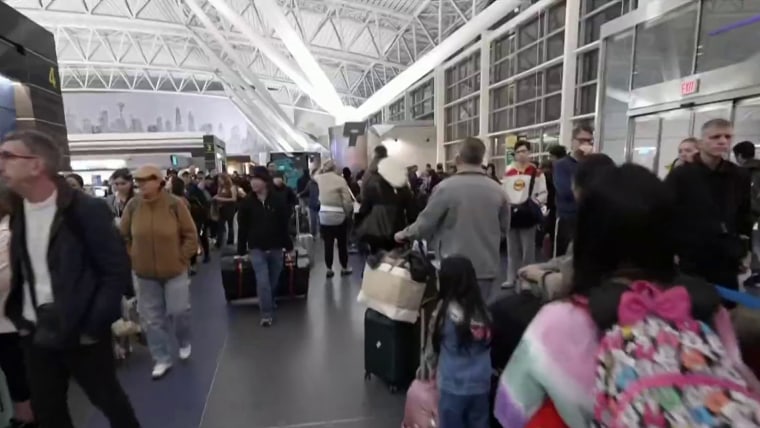

Travelers frustrated by long security lines may not see immediate relief, even as Transportation Security Administration officers begin receiving pay again on Monday after working without wages for more than a month during the partial government shutdown.

President Donald Trump signed an executive order Thursday directing federal officials to ensure that TSA workers are paid despite the shutdown, breaking a more than 40-day stretch in which officers went without salaries.

But the move is unlikely to bring instant relief at airport checkpoints, according to former TSA Administrator John S. Pistole.

“It’s a temporary fix,” he told NBC News.

The more pertinent question, he said, is how many workers actually return to their posts now that paychecks are set to resume Monday.

More than 500 officers have quit during the shutdown, according to the Department of Homeland Security, while thousands more have called out because they can’t afford basic expenses.

TSA callout rates reached a high of 12.35% of the workforce on Friday, accounting for more than 3,560 employees, a DHS spokesperson said Saturday. The department added that at Trump’s direction and under Homeland Security Secretary Markwayne Mullin, TSA has “immediately begun the process of paying its workforce” and that officers “should begin seeing paychecks as early as Monday, March 30.”

Those shortages have forced travelers to contend with missed and canceled flights, long security lines and growing uncertainty around air travel.

If most officers report back beginning Monday and airports are able to restore staffing, wait times could start to ease within several days to a couple of weeks, Pistole said.

“It really depends on that asterisk of how many people show up,” he said.

Some workers who left may already have other jobs lined up, raising questions about whether some will return at all.

“How many of them come back after they get this paycheck? Or maybe they already have another full-time job lined up, they’re just waiting to inform TSA after they get their check on Monday,” Pistole said. “So there are a number of variables there.”

Pistole said the uncertainty, coupled with TSA’s typical annual attrition rate of about 7%, could mean delays will continue even after pay resumes.

Until then, some travelers may want to consider alternatives such as driving, rail or bus.

“I think many will and are looking at those options to say, ‘Is that more reliable? Because the last thing I want to do is get to Bush International Airport in Houston and have a four-hour wait,’” Pistole said.

Todd and Janet Gatewood launched their Nashville-based radio show “God, Freedom and Bitcoin” in January, blending their passion for cryptocurrency with their strong faith.

Then the market crashed. At roughly $69,000 on Thursday, the price of the cryptocurrency is down by 45%, struggling to recover and nowhere near the $126,000 high it reached in October.

But the couple sees the slide as a blessing.

Janet, a real estate agent in the Nashville, Tennessee, area, told her husband and a guest appearing on a Feb. 9 show that she hoped to close on more houses, so she could buy bitcoin at a lower price.

“This is what we call ‘on sale,’” she said. “Buy the dip. If you’ve ever heard anything in the bitcoin space, this is when you want to buy.”

The Gatewoods are among a diverse group of Christian financial influencers, entrepreneurs and even pastors working to pitch the faithful on digital currencies. Their positions vary — some are bitcoin hard-liners. Others dabble in meme coins — crypto assets that are quickly spun up and traded around memes and cultural moments.

During this time of volatility, some of the Christian investors who are following them are doubling down.

“It’s not fazing me at all,” said Alicia Tappin, 55, who has purchased bitcoin during the dip. “I’m not emotionally tied to it right now — if I was I would be a wreck.”

Tappin said she follows updates from a Christian businesswoman named Michelle Renee, whose firm charges $499 a year for a VIP membership that provides access to webinars, its “cryptocurrency watchlist” and a Telegram chat.

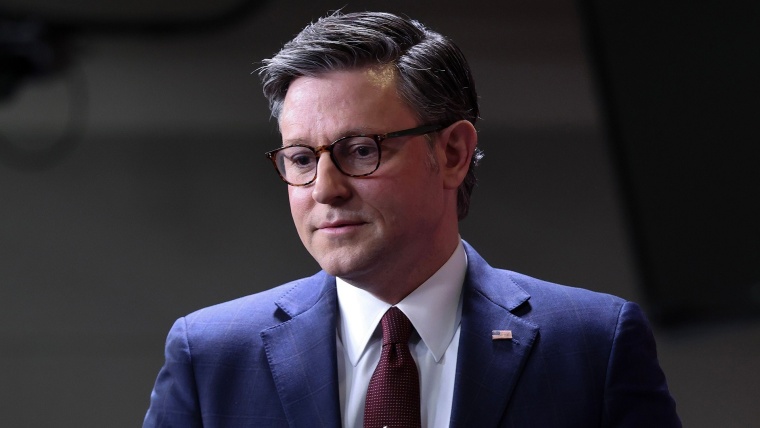
WASHINGTON — House Republicans voted Friday evening to pass a short-term funding bill for the Department of Homeland Security that has no viable path in the Senate and is likely to extend the shutdown stalemate on Capitol Hill.

The vote of 213-203 came after Speaker Mike Johnson, R-La., rejected the Senate-passed bill, which would fund all of DHS except Immigration and Customs Enforcement and Customs and Border Protection. Funding for DHS lapsed in mid-February.

He called the Senate measure “a joke,” placing full blame for it on Democrats, even though Republicans control the Senate and the bill passed by unanimous consent early Friday morning.

“They have taken hostage the funding processes of government so that they can impose their radical agenda on the American people,” Johnson told reporters before the House vote.

His remarks came around the same time President Donald Trump signed an order directing the Department of Homeland Security to pay Transportation Security Administration employees who have missed paychecks during the DHS shutdown, leading to high TSA callout rates that have created long lines for passengers at U.S. airports. The dollar amount and authority for tapping the funds was not immediately clear, but a DHS spokesperson said paychecks should start arriving as early as Monday.

We’d like to hear from you about how you’re experiencing the partial government shutdown, whether you’re a TSA agent who can’t work right now or a federal employee who is feeling the effects at your agency. Please contact us at tips@nbcuni.com or reach out to us here.

The House-passed bill, which would fund DHS through May 22, is not expected to become law. The Senate left town Friday for a two-week recess, and Democratic senators have consistently vowed to block funding for ICE and CBP without constraints on immigration enforcement operations.

Asked if Trump has endorsed his plan, Johnson told reporters on Friday afternoon: “I spoke to the president a few moments ago; he understands exactly what we’re doing and why, and he supports it.”

Senate Majority Leader John Thune, R-S.D., has no plans to bring back the Senate because there is no realistic path to passing the House bill, a GOP aide told NBC News.

The belief among Senate Republican leadership is that it does not make sense to pursue a path other than the bipartisan bill to fund the Department of Homeland Security, minus ICE and CBP, that the Senate passed early Friday morning, according to a senior GOP aide.

The Senate over the past six weeks has attempted to pass numerous measures identical to the one passed by the House on Friday night, and all have failed in the face of Democratic opposition.

Senate Minority Leader Chuck Schumer, D-N.Y., warned that a House bill that funds ICE and CBP without guardrails would go nowhere in the Senate, where it would require 60 votes to advance. Republicans hold a 53-47 majority.

“We’ve been clear from day one: Democrats will fund critical homeland security functions — but we will not give a blank check to Trump’s lawless and deadly immigration militia without reforms,” Schumer said, adding that the House GOP’s short-term funding bill would be “dead on arrival in the Senate, and Republicans know it.”

House Minority Leader Hakeem Jeffries, D-N.Y., sided with Schumer in favor of the Senate-passed bill.

“We have this bipartisan bill sent over by the Senate that House Democrats are prepared to support,” he told reporters Friday. “If that bill is brought to the floor today it will pass. The Trump-Republican DHS shutdown will be over. Unfortunately, MAGA extremists in the House of Representatives continue to inflict pain on the American people.”

Johnson put forward the short-term funding bill after a bloc of House conservatives expressed outrage over the Senate-passed measure and vowed to vote against it, complicating any move toward swift passage in the House.

Rep. Ralph Norman, R-S.C., called the Senate bill “irresponsible” and added that voter identification provisions and parts of ICE funding must be included.

“Those two things will have to be in,” he said.

Rep. Susie Lee, D-Nev., said Democrats won’t support a bill to fund ICE without constraints after immigration enforcement agents killed two Americans in Minneapolis.

“I think we made it very clear, and the American public is demanding some sort of guardrails on an agency that has basically terrorized communities across this country, resulted in the death of two American citizens,” she said. “We have shone a light on just how rogue ICE was acting.”

Leaving the Capitol on Friday, Johnson told NBC News that he gave Thune a heads up before deciding to reject the Senate-passed measure and its omission of funding for ICE and CBP.

“We talked today, and I told him it shouldn’t be a surprise to anybody we would not be able to do that,” Johnson said. “We’re not going to split apart two of the most important agencies in the government and leave them hanging like that. We just couldn’t do it.”

FIRST ON FOX: States that decline to opt in to the Education Freedom Tax Credit (EFTC) could forgo nearly $23 billion in education funding over the next three years, according to a new analysis from the America First Policy Institute.

To highlight those potential losses, the group will launch an interactive Funding Loss Calculator designed to show how much each non-participating state stands to lose in charitable donations tied to the federal tax credit program. 

GET RID OF THE EDUCATION DEPARTMENT. GIVE POWER TO PARENTS

The projections estimate that 23 states could miss out on nearly $23 billion between 2027 and 2029—equivalent to more than 4.1 million lost scholarship opportunities for students.

“We wanted to make sure that governors know and especially, the people in the states know, what is being foregone if they do not opt in to this federal tax credit scholarship program,” Erika Donalds, chair of educational opportunity at AFPI, told Fox News Digital.

“The program will provide not just private school tuition, but homeschool expenses, curriculum assistance, tutoring, special needs services, dual enrollment and so many other resources for families,” Donalds said, adding that the funds come from private donations and not state budgets.

She added that, so far, 28 governors have opted into the program.

LA UNITED SCHOOL DISTRICT SCANDAL LEADS TO CHARGES AS $22M SCHEME ALLEGEDLY DRAINED FUNDS MEANT FOR STUDENTS

Under the policy, taxpayers can receive up to $1,700 in dollar-for-dollar federal tax credits for donations to scholarship-granting organizations, which fund K–12 expenses such as private school tuition, homeschooling, tutoring and special needs services. But only students in participating states are eligible to benefit.

That means taxpayers in states that opt out can still claim the credit—but their contributions are redirected to organizations in other states, effectively sending education funding elsewhere.

As a result, the calculator allows users to model different participation rates and view projected losses on a state-by-state basis. Supporters say the tool is meant to underscore the potential consequences for governors weighing whether to join the program.

“Every parent deserves to make education decisions on behalf of their children. We have seen state after state where parents are begging for school choice options,” Donalds said.

“In Texas, in just one month, 250,000 applicants for a school choice program that is only going to accommodate about 80,000 students. In Tennessee, over 50,000 applications for a program that accommodates 20,000 students. There should not be wait lists on education freedom,” she added.

A political newcomer and former reality star running in Virginia’s Democratic senatorial primary is causing an uproar in his party after breaking with them on gerrymandering and a slew of new gun control efforts.

Mark Moran, a former contestant on the HBO Max series “FBoy Island” and previously a Wall Street banker, is challenging longtime Senate Intelligence Committee ranking member Mark R. Warner, D-Va., whom he calls an “oligarch” who is no longer serving his constituents.

Warner is the former richest and now fourth-richest senator, with a net worth upwards of $200 million, and is running for his fourth term despite a snippet unearthed by Moran showing him pledging to serve only two.

“Since the establishment is already mad at me, here’s another truth: Virginia Democrats are completely wrong on the Second Amendment,” Moran said on X after invoking the ire of Virginia’s top Senate Democrat for opposing her politically charged redistricting effort.

YOUR 2A RIGHTS ARE ON THE CHOPPING BLOCK AS VIRGINIA DEMS PLOT INSANE GUN BANS

“After facing a personal safety issue, I got a gun. It made me realize how extreme our party’s stance has become,” Moran said. “Dan Helmer’s (loser) July 1st ban literally classifies regular handguns as ‘assault firearms’ so the government can take them away.”

Helmer, a Democratic state delegate from Fairfax, did not respond to a request for comment. He has already launched a bid to run in one of the newly drawn congressional districts that have yet to be approved by the voters on April 21.

Moran said the Founding Fathers crafted the Second Amendment to protect the U.S. from tyranny.

“[That is] whether that tyranny comes from Donald Trump or a state legislature trying to disarm you. Our right to protect ourselves shall not be infringed,” Moran said.

The Falls Church native’s comments irritated a handful of other Democratic figures within a few hours of his post, including Democratic strategist Adam Parkhomenko — the founder of “Ready For Hillary” when the former first lady was eyeing the White House in the mid-2010s.

GOP-LED COUNTIES PUSH BACK AGAINST DEMOCRAT’S REDISTRICTING CHARGE, TESTING VIRGINIA’S CONSTITUTIONAL LIMITS

“Go be a p—- in someone else’s party. We’re not doing that anymore,” Parkhomenko said on X in response to Moran.

Virginia Senate President L. Louise Lucas, D-Portsmouth, who has posted at times raunchy memes celebrating Democrats’ flip of the governorship and push to draw out all but one Republican congressman in Virginia, lambasted Moran’s tweet on that matter, spurring his gun rights commentary.

“Anyone against our redistricting efforts to stand up to Donald Trump doesn’t share our values as Democrats,” Lucas said in a statement on X. “If you want to oppose redistricting, you picked the wrong primary to run in. [By the way] I endorse Mark Warner.”

Moran had called his fellow Democrats’ cartographical creativity “extremely anti-democratic and that it is a reactionary policy to Donald Trump that was created by DC consultants.”

He noted that Virginia voters already approved a resolution in 2019 to remove the legislature from redistricting considerations and slammed the new maps for “slic[ing] up Arlington and tak[ing] away the voices of everyone outside Northern Virginia.”

“In every local Democratic committee I’ve been in, when this issue comes up, nobody can defend it, it’s just ‘well this is what the party says is best’ – NO. The Democratic Party loses because of reactionary maneuvers and because it doesn’t have a big bold vision for the future,” he said.

VIRGINIA DEM ADMITS REDISTRICTING PUSH AIMS TO ‘STOP TRUMP’, NOT ABOUT ‘FAIRNESS’

“I can’t hold my tongue any longer despite what this will do to me with the Dems in Virginia.”

Moran also has spoken out against the proliferation of data centers, sucking up power from the grid in both West Virginia and Virginia and allegedly increasing costs on residential consumers.

He posited a plan to tax the data centers to create a free-college fund.

While Moran came across as moderate on those issues, a report from the New York Post showed his campaign platform includes abolishing ICE and passing “Medicare-for-all,” which the paper said places him to Warner’s left on those key issues.

“This year is the 250th anniversary of our country; now is the time for a peaceful revolution against the billionaires, the tech oligarchs, the data centers and all the other big money interests,” he said in a statement obtained by the Post.

Fox News Digital reached out to Warner’s campaign, Moran’s campaign and Gov. Abigail Spanberger’s office for comment.

The U.S. government will allow a Russian tanker full of crude oil to reach Cuba, effectively easing a blockade that has pushed the island into an energy crisis, according to a report.

The Russian-flagged tanker, the Anatoly Kolodkin, was headed for Cuba on Sunday, carrying an estimated 730,000 barrels of oil, The New York Times reported, citing a U.S. official who had been briefed on the matter.

The tanker Anatoly ⁠Kolodkin was just off the eastern tip of Cuba on Sunday, ship tracking data showed.

“We have a tanker out there. We don’t mind having somebody get a boatload, because they need … they have to survive,” President Donald Trump told reporters on Sunday when asked about the report.

CUBA’S ENTIRE ELECTRICAL GRID COLLAPSES, LEAVING WHOLE ISLAND WITHOUT POWER

“If a country wants to send some oil into Cuba right now, I have no problem whether it’s Russia or not,” he added.

Trump had sought to restrict oil shipments to Cuba in an effort to pressure its government.

The U.S. government has temporarily eased some sanctions on Russian oil shipments to help stabilize global energy markets amid disruptions in the Strait of Hormuz following U.S. and Israeli military strikes on Iran that began last month.

CUBAN OFFICIAL REVEALS MILITARY ‘PREPARING’ FOR CONFLICT AFTER TRUMP CONSIDERS ‘TAKING’ ISLAND

The Anatoly Kolodkin, which departed from Primorsk, Russia, could soon dock at the Matanzas port in Cuba if it remains on its current path, according to tracking services MarineTraffic and LSEG.

The oil would provide significant relief to Cuba, where President Miguel Díaz-Canel has said fuel shortages have persisted for months, forcing strict gas rationing and deepening the island’s energy crisis.

The U.S. capture of then-Venezuelan leader Nicolás Maduro in January stripped a key Cuban ally who had been providing oil to the island on favorable terms.

The Trump administration then blocked all Venezuelan oil shipments to Cuba and vowed to impose punitive tariffs on any third country that supplied shipments to the island, forcing Mexico to stop its exports to Cuba.

Another ship, the Hong Kong-flagged Sea Horse, was also carrying about 200,000 barrels of Russian fuel to Cuba, but was rerouted to Venezuela.

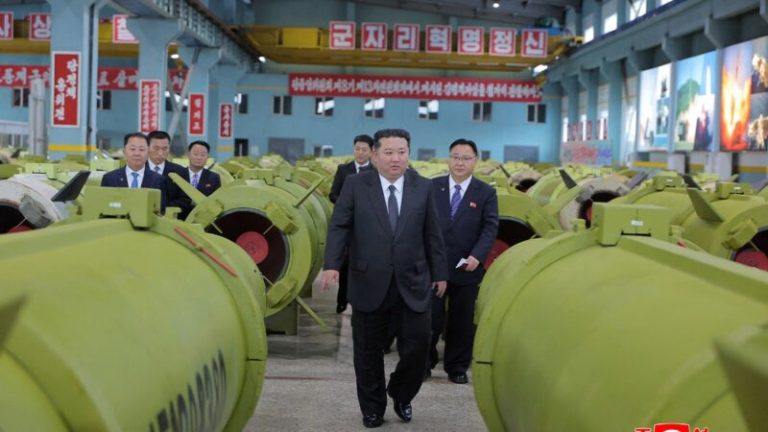
The Islamic Republic of Iran’s vast missile system is the brainchild of the U.S.-designated state-sponsor of terrorism, the communist North Korea regime, which works hand in glove with Iran, according to one of the world’s leading experts on the Iran-North Korea strategic alliance.

“The missile launched at Diego Garcia was a Musudan. The Iranians bought 19 of these from the North Koreans and took delivery in 2005. They have had this capability since 2005 — and this is no ‘secret weapon,’” Bruce Bechtol, who co-authored with Anthony Celso the groundbreaking book “Rogue Allies: The Strategic Partnership Between Iran and North Korea,” told Fox News Digital.

Fox News Digital reported last week that Iran significantly escalated its war effort against the U.S. with its launch of two intermediate-range ballistic missiles toward Diego Garcia—roughly 2,500 miles from Iran.

TRUMP PROVEN RIGHT ON IRAN’S LONG-RANGE MISSILE CAPABILITY AS REGIME TARGETS US-UK BASE, EXPERTS SAY

Bechtol said, “The most important threat from Iran as the war with the United States and Israel has evolved has been the ballistic missiles, launched not only at U.S. facilities and Israeli cities, but also at neighboring Islamic countries. Thus, it is important to consider this capability and where Iran got it.”

He said, “The short-range ballistic missiles that Iran has launched at key U.S. facilities and at neighboring Arab states include a key system – the ‘QIAM.’ The QIAM was developed and improved with North Korean assistance… North Korea has proliferated a lot to Iran that we are seeing right now in the war.”

The joint U.S.-Israeli war against Iran’s regime, the world’s worst state-sponsor of terrorism, according to the U.S. State Department, has entered its fifth week.

Bechtol, who is a professor of political science in the Department of Security Studies at Angelo State University in Texas, noted that, according to the Wisconsin Project, North Korea had constructed a large missile test facility at Emamshahr, a city in the Fars Province in Iran, and a tracking facility at Tabas in South Khorasan province.

He said North Korea aided Iran with crucial technology “for targets farther away from Iran.”

“The North Koreans proliferated around 150 No Dong systems to Iran in the late 1990s. The Iranians were apparently very happy with the missiles the North Koreans provided them, and, following the earlier precedent of the Scud C factory, contracted with Pyongyang to build a No Dong facility in Iran.”

AFTER THE STRIKES, HOW WOULD THE US SECURE IRAN’S ENRICHED URANIUM?

Bechtol continued, “The Iranians called this ‘new’ missile the Shahab-3. The Shahab-3 is almost an exact copy of the No Dong. Once the Shahab-3 was up and running, the North Koreans moved forward with the Iranians in improving its range and lethality.”

He said, “With assistance from the North Koreans, the Iranians were then able to produce (at the No Dong facility) the Emad and the Ghadr. The Emad has a range of 1,750 kilometers (approx 1,087 miles) and the Ghadr has a range of 1,950 kilometers (approximately 1,212 miles.) The Iranians have used these two systems to target not only Israel, but their Arab neighbors (including U.S. bases located in these countries) throughout the ongoing first stages of this conflict.”

Bechtol said the North Koreans spawned an Iranian missile warhead that weighs a ton and a half to two tons on the powerful Khorramshahr-4. “There is another system capable of hitting Israel that has been even more lethal than any of the systems described thus far. This system is called the ‘Khorramshahr,’ and the fourth version of this system, appropriately called the ‘Khorramshahr-4,’ has been proven to carry a warhead larger than any other in Iran’s missile inventory, armed with what appears to be cluster munitions,” he said.

He described the strategic partnership, noting: “North Korea is the seller and Iran is the buyer. North Korea proliferates weapons systems, technology, parts and components, technicians, engineers and specialists and military capabilities (such as the building of underground facilities) to Iran. Iran pays North Korea with cash and oil. Simple as that.”

Bechtol said the only way to stop this is through sanctions enforcement against North Korea. “The sanctions that are needed are already on the books. But the USA and our key allies need to robustly enforce them. We need to go after banks, front companies and cyber entities in order to squeeze the money and contain or destroy the supply chain.”

He said, “More emphasis needs to be placed, and more action needs to be taken using the Proliferation Security Initiative — an underused aspect of preventing North Korea’s arms from flowing to rogue nations and terrorist groups.  If you cut off the supply chain, you cut off the proliferation.”

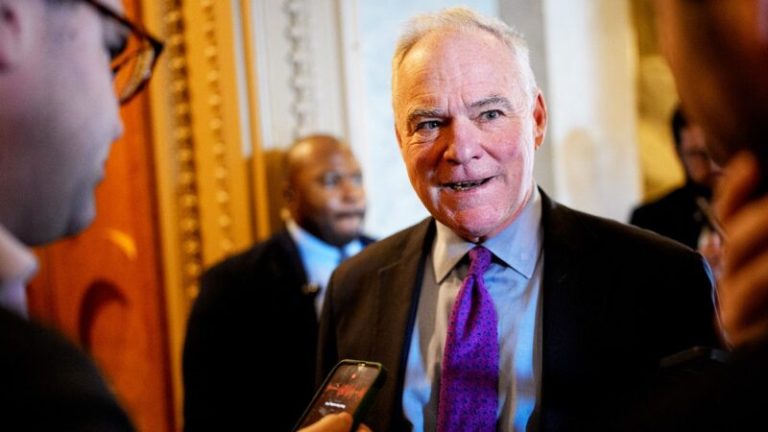
Sen. Tim Kaine, D-Va., is calling on prosecutors to try, convict and punish the undocumented killer of Stephanie Minter, arguing that he must face American justice before he’s ordered to leave the country.

Kaine said he fears deportation could be a form of leniency.

“I’m not sure that if he’s deported, [that] he will really face the punishment that he should face. If you do a deportation now, what’s the guarantee he would really face severe consequences for what he’s done?” Kaine said.

“I think he should be prosecuted to the full extent of the law and then possibly deported after that, but I wouldn’t want him to escape accountability for the crime.”

TRUMP ADMIN ASKS SPANBERGER, VIRGINIA OFFICIALS NOT RELEASE ILLEGAL CHARGED WITH GROPING HIGH SCHOOL GIRLS

Authorities are charging Abdul Jalloh, a 32-year-old Sierra Leone native, with the murder of Stephanie Minter after authorities found her dead at a bus stop in Fairfax, Virginia last month.

Jalloh had already been arrested more than 30 times before his fatal confrontation with Minter, according to the Department of Homeland Security. Among others, his previous charges included rape, malicious wounding, assault, drug possession, identity theft, trespassing and more.

Local authorities dropped previous charges against Jalloh, allowing him to walk free.

IGNORED ICE DETAINERS ‘PUT LIVES AT RISK,’ DHS SAYS, TARGETING NEWSOM, PRITZKER, HEALEY

Kaine believes this time should be different.

“I think he should be prosecuted to the full extent of the law and then possibly deported after that,” Kaine said.

Jalloh has been charged with second-degree murder.

Even as questions remain about why Virginia authorities let Jalloh go, Kaine, who served as governor of Virginia from 2006 to 2010, posited that ICE may have failed to follow through on requests to detain Jalloh ahead of Minter’s murder.

“My experience when I was governor — and this is now 15 or 20 years ago — is that we would normally let ICE know before we let anybody out of prison in Virginia, and then they wouldn’t show up,” Kaine said.

VIRGINIA PROSECUTOR’S RECORD ON VIOLENT OFFENDERS SCRUTINIZED AFTER ILLEGAL IMMIGRANT CHARGED IN MOM’S MURDER

“We would give them two weeks’ notice [and say] ‘Hey, here’s somebody who’s here, come pick them up,’ and they wouldn’t show up. That was more my experience.”

Fox Digital reached out to the Department of Homeland Security for comment.

President Donald Trump is used to bending financial markets to his will.

But with the war in Iran, he may have reached the limit of his ability to do so.

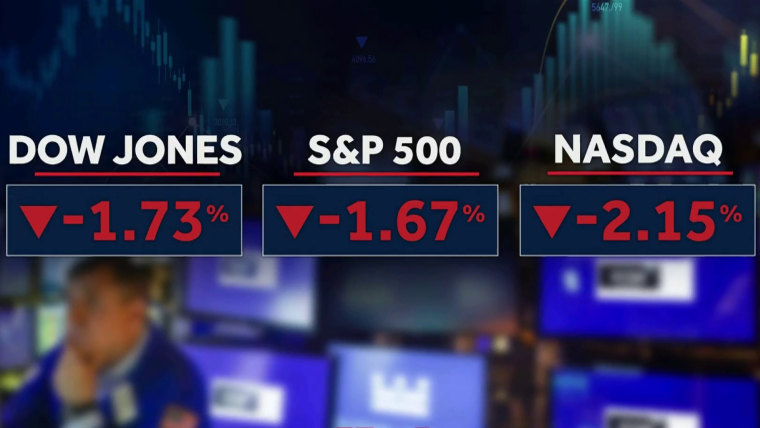
On Friday, the S&P 500 closed down 1.7% and notched its fifth-straight weekly decline, its worst stretch since 2022 and a sign of rapidly faltering confidence in a swift resolution to the Iran war.

Since the U.S. attacked Iran on Feb. 28, the S&P 500 has declined about 7%.

The Dow Jones Industrial Average fell 1.7% Friday and has lost nearly 4,000 points since the start of the war. It is now down more than 10% from its most recent high, a correction in technical terms.

The tech-heavy Nasdaq fell further into correction territory Friday, closing down 2% and off 13% since its record close in October.

Oil prices also rose sharply, with U.S. crude topping $100 a barrel and global Brent crude at approximately $114 at around 4 p.m. ET. The yield on the 10-year Treasury note surged to 4.4%, the highest since last summer. Some energy stocks, like Exxon, traded near all-time highs.

Shortly after stock markets had closed Thursday, Trump announced he was pausing attacks on Iranian energy sites for 10 days. But stocks barely budged.

Just days earlier, they had rocketed higher Monday when the president announced there had been “productive” talks with Iranian representatives, so he would pause strikes on Iranian power facilities for five days.

“The market is looking beyond commentary from the administration,” said Adam Turnquist, chief strategist at LPL Financial investment group, which manages nearly $2 trillion in assets. “They actually want concrete details and a resolution. And actions speak louder than words, that’s really present in [current] price action.”

This new reality stands in contrast to Trump’s ability to move markets throughout his first term and into the outset of his second.

Trump spent the better part of 2025 whipsawing traders via frequent changes regarding tariff levels. Eventually, a pattern emerged: The president would announce a new import duty, markets would fall, and Trump would usually end up reversing himself in some way.

The trend even got a nickname, coined by a columnist for the Financial Times: “TACO” — for “Trump Always Chickens Out.” (Last month, the Supreme Court struck down many of the tariffs.)

This time, the chain of events unleashed by Trump’s decision to attack Iran are such that a return to prewar conditions — and market levels — is virtually impossible in the short or even medium term, experts say.

The disruption to flows of oil and gas has been so substantial that transport costs, and ultimately the price paid per barrel, are likely to stay elevated indefinitely. Even when the Strait of Hormuz, which Iran has used as a chokepoint to drive concessions from the West, eventually reopens, the cost of transiting through it has likely gone up for the foreseeable future.

And the broader fallout on the economy and consumer purchases is already being felt.

That, in turn, has made interest rate cuts by the Federal Reserve less likely, because the higher oil costs are set to contribute to already sticky inflation. The odds of a rate hike before the end of the year have now outpaced the odds of a cut.

“Let’s say hostilities end tomorrow — the market will rally, but it’s not necessarily ripping back to where it was before because of the disruptions that have occurred,” said Steve Sosnick, chief strategist at Interactive Brokers financial group. “You’re not going to see oil go back to where it was immediately. You’re not going to see markets price in rate cuts the way they were before.”

White House spokesman Kush Desai said Friday that Trump “continues to be a powerful force driving the market’s confidence in the United States as the most dynamic, pro-business economy in the world.”

“Once the military objectives of Operation Epic Fury have been achieved and the market’s short-term disruptions are behind us, everyday investors are set to reap a windfall in a booming American economy,” Desai said.

A day earlier, the president said he was not concerned about the market’s recent performance.

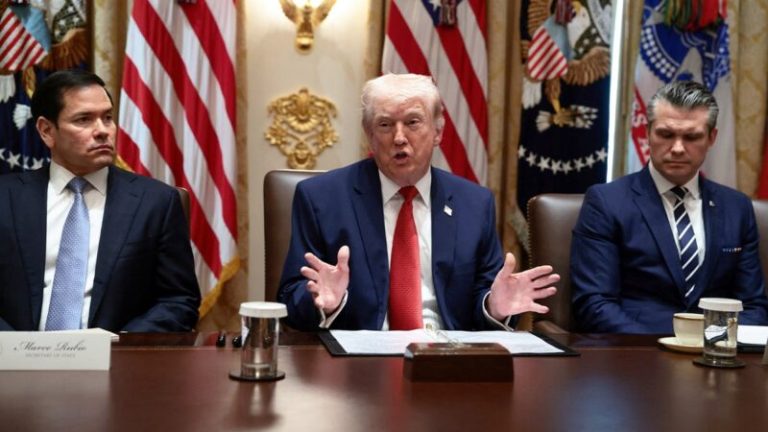
Oil prices “have not gone up as much as I thought, Scott, to be honest with you,” he said during a Cabinet meeting, addressing Treasury Secretary Scott Bessent. “It’s all going to come back down to where it was and probably lower.”

Markets have not fallen further because the outlook for earnings growth remains bullish, Turnquist said — though that could change the longer the conflict drags on and further impinges on consumer spending and business investment.

And compared to prior oil shocks, the U.S. economy is less oil-intensive, as it has transitioned to one that is largely service-oriented. Global oil markets have also been supported by America’s oil production boom over the past decade — with more supplies online, overall prices are less likely to rise as much.

Yet by some metrics, stocks were already considered expensive prior to the hostilities. Having already contended with stretched valuations, traders may find it much harder to power stock prices back to the record levels seen just prior to the start of the latest conflict.

“The risk-reward is still very heavily weighted toward [the] risk” of further stock-price declines,” said Matt Maley, chief market strategist at Miller Tabak financial group.

Should hostilities persist, Trump’s ability to influence markets will only further erode, Sosnick predicted.

“He now realizes he’d like to jawbone his way out of it, but it’s not that easy at this point because the situation encompasses so many moving parts and difficult variables,” Sosnick said. “It doesn’t lend itself to a quick set of comments mollifying investors.”